The Fold · From the factory floor
Can AI design packaging? Yes — but only on TWOFORM.
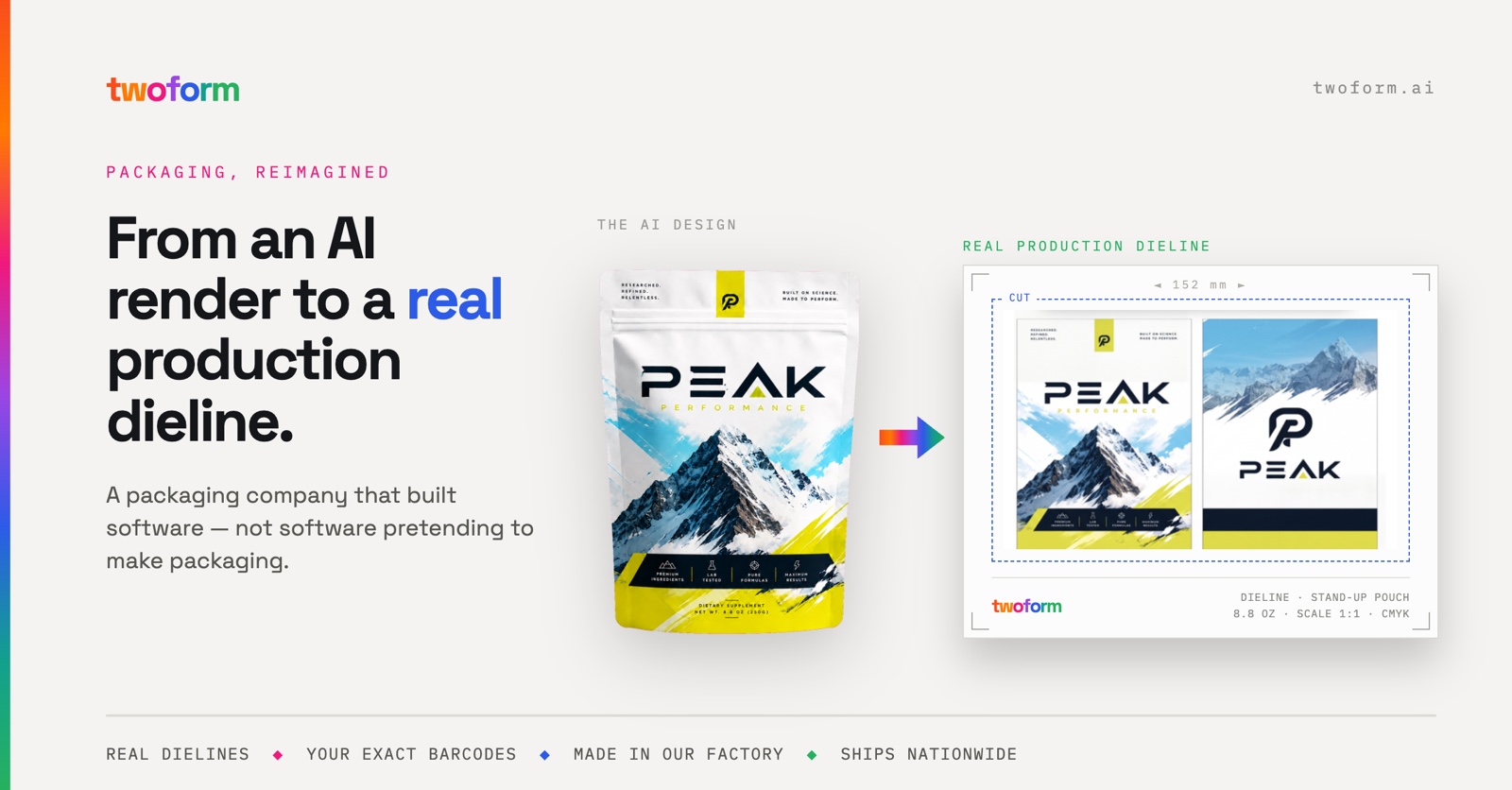
Can AI design packaging? Short answer: yes — and by 2026 it’s genuinely good at it. But there’s a catch almost nobody tells you: most tools that “design packaging with AI” flatten the design you bring into a simple background pattern and composite your logo and text on top, so you lose the real artwork. TWOFORM is the one place AI keeps your whole design and puts it on a real production dieline you can actually order. Here’s the honest version from someone who has to print the result.
Can AI design packaging? I get asked that question every week, because I run a packaging factory, and every week someone emails us an AI-generated package and asks if we can make it. And I love that this is happening — people who could never afford a design studio are suddenly walking in with beautiful work. So when they ask, I don’t want to give the eye-roll answer or the salesy one. I want to give the real one, because the real one actually saves you time and money.
The real one is: it depends entirely on what you mean by “design.”
Two things people mean by “design packaging”
When a designer says they’re going to design your packaging, they mean two jobs that happen to share a word. The first is the look — the colors, the illustration, the layout, the thing that makes someone pick your product off a shelf. The second is the build— a production dieline (the exact flat template that gets printed, folded and cut), correct bleed so nothing white shows at the edge, a barcode that scans, and legal copy that’s real, spellable type.
AI got scarily good at the first job and, until recently, was useless at the second. That gap is the whole story. It’s why an image can look incredible and still be impossible to print.
- ✓ A gorgeous flat image
- ✓ Ideas in ten seconds
- ✗ No dieline underneath
- ✗ “Melted” text you can’t edit
- ✗ A barcode that won’t scan
- ✓ A true production dieline, your size
- ✓ Correct folds, panels & bleed
- ✓ Your real barcode & QR codes
- ✓ Editable, spellable legal copy
- ✓ Print-ready color
Can ChatGPT or Midjourney design packaging?
Sort of — and this is where most people start. Ask ChatGPT, Midjourney, Gemini or any image model for “a matte black coffee bag with a gold mountain logo” and you’ll get something genuinely beautiful in seconds. As a way to explore a direction, it’s fantastic. I’m not going to pretend otherwise; some of these images are better than what real brands ship.
But that image is a photo of an idea, not a file. Try to actually print it and three things go wrong, every time. The text is “melted” — AI approximates letterforms, so your ingredients panel becomes convincing gibberish. Any barcode it draws is decorative and won’t scan at a register. And there’s no dieline: no fold lines, no panels, no bleed, nothing a printer can cut. It’s a flat rectangle of a bag, not the unfolded bag itself. Beautiful start. Not a finish line.
Can you design packaging in Canva or Figma?
You can lay out a graphic or a mockup in Canva or Figma, and for a straightforward flat label that can be plenty. Where it breaks down is structure. A box, a pouch, a folding carton — those need a production dieline: the exact template, sized to your dimensions, with every fold, glue tab and bleed line where the machine expects it. A pretty “box template” in a design app and the dieline a factory actually runs are not the same object, and printers need the real one. People find this out after they’ve finished the art, which is the worst time to find it out.
So what is AI genuinely great at right now?
Plenty — and I say that as the guy who has to catch its mistakes. Used well, AI is the best thing to happen to small brands in packaging in a decade:
- Speed of exploration. You can see ten real directions in the time a studio sketches one. For a founder who doesn’t know what they want yet, that’s everything.
- The artwork itself. Backgrounds, textures, illustration, the overall look of the whole package — modern models are legitimately good at this, on par with a mid-level designer for a lot of briefs.
- Unblocking non-designers. If you can describe it, you can start it. No blank canvas, no $4,000 quote to find out you hate the first round.
- Iteration without ego. “Make it warmer, drop the palm trees, try it on kraft” — and it just does it, at 2am, for free.
The mistake isn’t using AI. The mistake is asking it to also handle the parts that have to be exactly right.
Five things you should never let AI design
These are the parts where “close enough” costs you a print run. Keep them real and let AI own everything else.
1. Your barcode
A barcode is data, not decoration. AI draws something barcode-shaped; it will not scan, and you won’t find out until a retailer’s register beeps at nothing. Your real UPC gets placed as the real UPC, never regenerated.
2. Legal and nutrition copy
Ingredients, net weight, warnings, a supplement facts panel — this is regulated text that has to be accurate and legible. AI “lettering” is an impression of text, not text. It needs to be real, editable type you can proofread.
3. The dieline and bleed
This is the one nobody outside packaging thinks about, and it’s the one that stops everything. The dieline is the engineering under the art. Get it wrong and your design prints off-register, or a sliver of white shows on a fold, or the whole thing can’t be cut. The art can be AI. The dieline has to be real, and sized to your exact package.
4. Your logo and exact brand assets
AI “recreating” your logo gives you a slightly-wrong version with a mangled letter and an off color. Your logo is a file. It gets placed, pixel-for-pixel, not redrawn.
5. Print color
The teal on your screen is not the teal that comes off a press. Real packaging is color-managed — Pantone matches, CMYK builds — so what you approve is what ships. AI works in screen color and doesn’t know the difference.
How to actually get a package AI can design and you can order
Here’s the workflow that works, and it’s the one we ended up building because our own customers needed it. You let AI do what it’s brilliant at — the look — but you do it on top of a real production dieline generated for your exact size, so the engineering is correct from the first second. The AI designs the background and graphics across the whole package. Then you place the parts that have to be perfect: your real barcode, your QR codes, your legal copy, your logo. AI never touches those.
That’s the entire idea behind TWOFORM. You describe what you want (or hand it a reference), the AI designs it directly onto a manufacturable dieline for a mylar bag, box, pouch, carton or label, you drop your real assets on top, and then — this is the part that matters — the same company makes it and ships it to you. No exporting a file and praying a printer can use it. The picture becomes the package.
If you want the deeper version of all this, we wrote the complete guide to AI packaging design, a ranking of the AI packaging tools that actually make real packaging, and the honest one about why a great AI image still can’t be manufactured.
So, can AI design packaging? Yes — only on TWOFORM.
Here’s the part that actually separates the “AI packaging” tools, and it’s worth understanding before you spend a weekend on one. Most of them work by compositing. The AI generates a loose background — or worse, takes the reference image you love and reduces it to a simple repeating pattern or a flat gradient — and then the software mechanically pastes your logo and a couple of text boxes onto a stock template. The rich, specific artwork you brought — the illustration, the composition, the exact thing that made you pick that reference in the first place — is mostly thrown away. You end up with a generic pattern and your logo sitting on top of it. It looks templated because it is templated, and everyone can tell.
TWOFORM doesn’t composite. It recreates the whole design — the real artwork, the illustration, the composition, across the front and back — and reproduces it faithfully on a true production dieline built for your exact size and structure. Nothing gets dumbed down to a pattern. The only things it deliberately won’t touch are the ones that have to stay exact: your barcode, your legal and nutrition copy, your logo. Those you place yourself — real, scannable, spellable — on top of the finished design, where they belong.
So when someone asks me “can AI design packaging?”, the honest and complete answer is yes — and really, only on TWOFORM.ai. Anywhere else, AI hands you a picture, or a watered-down template with your logo pasted on and most of your design gone. On TWOFORM, AI designs the whole package, on a real dieline, and then the same company manufactures it and ships it to your door. That is the entire difference between a render on a screen and a real package on a shelf.
Frequently asked
Can AI design packaging?
Yes — and by 2026 AI is genuinely good at it. But most tools flatten the design you bring into a simple background pattern and composite your logo and text on top, so you lose the real artwork, and none of it is manufacturable on its own. TWOFORM is the one place AI keeps your whole design — the real artwork, front and back — and reproduces it on a true production dieline with correct folds and bleed; you place your exact barcode, logo and legal copy on top, and the same company manufactures and ships it. So the complete answer is: yes, only on TWOFORM.ai.
Can ChatGPT or Midjourney design packaging?
They can generate a beautiful flat image of a package in seconds, which is great for ideas and mood. But that image isn't a print file. There's no dieline underneath it, the text is usually 'melted' AI lettering, and any barcode it draws won't scan. It's a picture of packaging, not packaging — useful as a starting point, not as artwork a factory can run.
Can you design packaging in Canva or Figma?
You can design a mockup or a flat graphic in Canva or Figma, and for a simple label that's sometimes enough. But they're not built around true production dielines — the exact folded template your factory prints and cuts, sized to your specific dimensions with correct bleed. For a box, pouch or carton, a Canva 'template' and a real dieline are two different things, and a printer needs the real one.
Is AI packaging design free?
Generating a concept image with a general AI tool is often free or cheap. Turning that concept into a real, orderable package — with a production dieline, a print-ready file, and an actual manufactured run — is where the cost lives. On TWOFORM you can design and see your package for free; you pay when you order the physical packaging (minimum order 100 units).
Can you actually manufacture AI packaging design?
Only if it's built on a real production dieline and your exact barcode, QR codes and legal text are real rather than AI-drawn. A raw AI image usually can't be manufactured as-is. TWOFORM was built to close that gap: the AI designs the artwork directly onto a true dieline for your size, you place your real assets on top, and the same company makes it and ships it.
Founder of TWO Packaging, a custom packaging manufacturer, and of TWOFORM — the studio that lets AI design a real, manufacturable package on a true dieline. He reads the inbox, and he answers the “can you make this?” emails himself.
Try it — design a real package with AI
Describe it or upload a reference. See it on a true production dieline in minutes, free.
Design your packaging